
Narzędzia użytkownika
Narzędzia witryny
Pasek boczny
en:statpqpl:wielowympl:logistpl:orpl
The Odds Ratio
Individual Odds Ratio
On the basis of many coefficients, for each independent variable in the model an easily interpreted measure is estimated, i.e. the individual Odds Ratio:

The received Odds Ratio expresses the change of the odds for the occurrence of the distinguished value (1) when the independent variable grows by 1 unit. The result is corrected with the remaining independent variables in the model so that it is assumed that they remain at a stable level while the studied variable is growing by 1 unit.
The OR value is interpreted as follows:
 means the stimulating influence of the studied independent variable on obtaining the distinguished value (1), i.e. it gives information about how much greater are the odds of the occurrence of the distinguished value (1) when the independent variable grows by 1 unit.
 means the destimulating influence of the studied independent variable on obtaining the distinguished value (1), i.e. it gives information about how much lower are the odds of the occurrence of the distinguished value (1) when the independent variable grows by 1 unit.
 means that the studied independent variable has no influence on obtaining the distinguished value (1).
Odds Ratio - the general formula
The PQStat program calculates the individual Odds Ratio. Its modification on the basis of a general formula makes it possible to change the interpretation of the obtained result.
The Odds Ratio for the occurrence of the distinguished state in a general case is calculated as the ratio of two odds. Therefore for the independent variable  for
for  expressed with a linear relationship we calculate:
the odds for the first category:

the odds for the second category:

The Odds Ratio for variable is then expressed with the formula:
![\begin{displaymath}
\begin{array}{lll}
OR_1(2)/(1) &=&\frac{Odds(2)}{Odds(1)}=\frac{e^{\beta_0+\beta_1X_1(2)+\beta_2X_2+...+\beta_kX_k}}{e^{\beta_0+\beta_1X_1(1)+\beta_2X_2+...+\beta_kX_k}}\\
&=& e^{\beta_0+\beta_1X_1(2)+\beta_2X_2+...+\beta_kX_k-[\beta_0+\beta_1X_1(1)+\beta_2X_2+...+\beta_kX_k]}\\
&=& e^{\beta_1X_1(2)-\beta_1X_1(1)}=e^{\beta_1[X_1(2)-X_1(1)]}=\\
&=& \left(e^{\beta_1}\right)^{[X_1(2)-X_1(1)]}.
\end{array}
\end{displaymath}](/lib/exe/fetch.php?media=wiki:latex:/img8ca8eb759969a75a643c17aa14eadef9.png "LaTeX")
Example
If the independent variable is age expressed in years, then the difference between neighboring age categories such as 25 and 26 years is 1 year  . In such a case we will obtain the individual Odds Ratio:
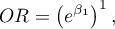
which expresses the degree of change of the odds for the occurrence of the distinguished value if the age is changed by 1 year.
The odds ratio calculated for non-neighboring variable categories, such as 25 and 30 years, will be a five-year Odds Ratio, because the difference  . In such a case we will obtain the five-year Odds Ratio:
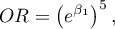
which expresses the degree of change of the odds for the occurrence of the distinguished value if the age is changed by 5 years.
Note
If the analysis is made for a non-linear model or if interaction is taken into account, then, on the basis of a general formula, we can calculate an appropriate Odds Ratio by changing the formula which expresses .
EXAMPLE cont. (task.pqs file)
EXAMPLE cont. (anomaly.pqs file)
en/statpqpl/wielowympl/logistpl/orpl.txt · ostatnio zmienione: 2022/02/15 19:35 przez admin
Narzędzia strony
Wszystkie treści w tym wiki, którym nie przyporządkowano licencji, podlegają licencji: CC Attribution-Noncommercial-Share Alike 4.0 International


